
Workspaces
Overview
Workspaces allow you to configure the content available in the right hand side of the Agent Messaging Console, as well as set what Catalog Messages are available as Snippets in the agent conversation view, for different groups of agents depending on the type of conversations they're handling.
For example, a team of Sales reps might need different tools, AI Assistants, fields, and Snippets exposed to them when working conversations than your Service reps do.
Creating and Configuring Workspaces
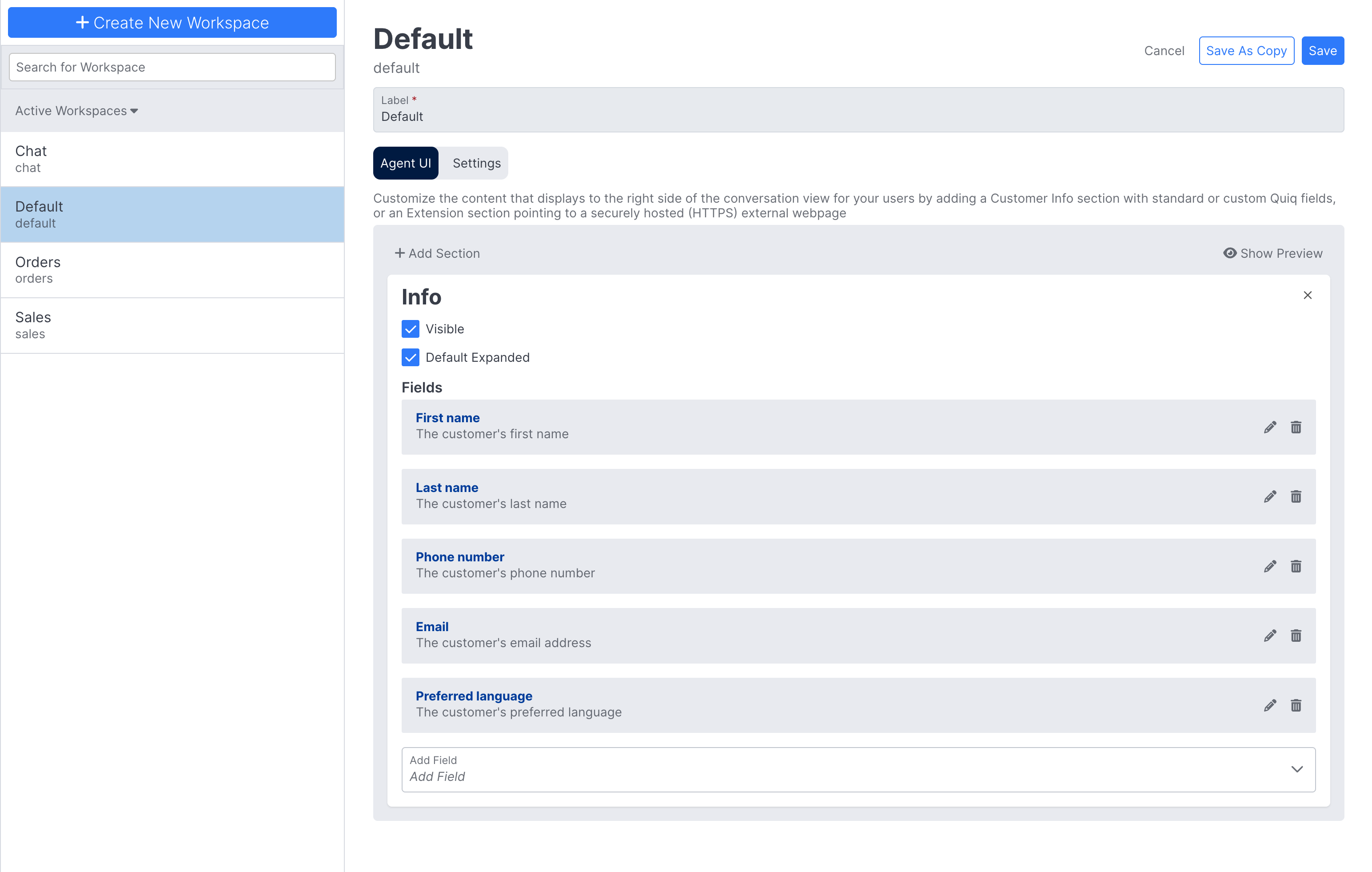
- Custom Workspaces can be added from the Workspaces Admin section within Quiq using the Create New Workspace button. A Default Workspace is automatically available and used by default when no custom Workspaces have been defined yet.
- When editing a Workspace, you can use the Save As Copy button to create a copy of that Workspace. This can be useful for scenarios where you may have the majority of the same content between Workspaces, but slightly different fields or custom extensions enabled.
Agent UI tab
On the Agent UI tab within a Workspace, you can create multiple different sections using the Add Section button to organize the content in the agent conversation view right hand side when using that Workspace, in a way that makes sense for your agents.
Adding Fields
You can select from a range of standard Quiq fields, along with Conversation and Customer Custom Fields, to be added to the conversation right hand side for a Workspace:
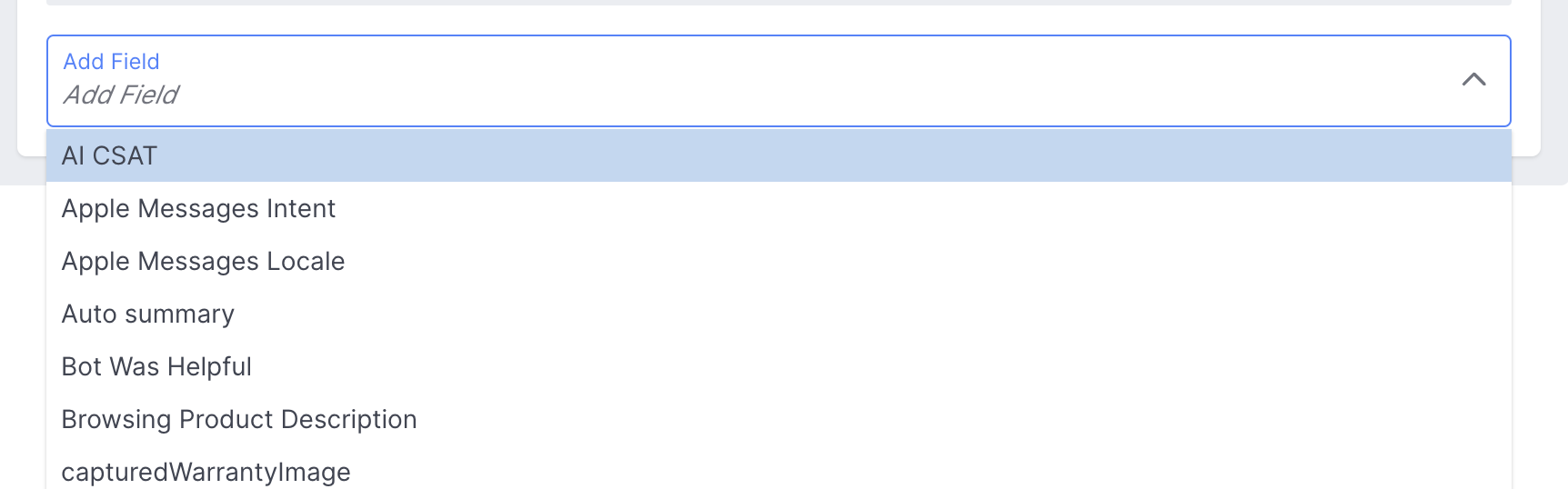
AI Agent fields will not be available for use in Workspaces, you must write those field values to either a Customer or Conversation Custom Field in order to use it in Workspaces.
Once added, you can add a specific label to your field, or mark it as required with the Required checkbox, meaning the field must have a value entered before an agent can close out the conversation:

A Read Only checkbox is also available for fields that aren’t already read-only by default, or set as Required in Admin > Custom Fields. When the Read Only checkbox is enabled for a field, that field will be read-only in the agent conversation view's right hand side section - so it can't be edited by an agent. Note that the Read Only & Required checkboxes are not allowed to both be checked at the same time - if one of those options is currently enabled and the other one is then checked, the first option is automatically unchecked.
A Hide When Blank checkbox is also available for fields that are read-only by default - when that option is enabled, the field will only display in the conversation right hand side if it’s populated, if it’s blank the field doesn’t display at all.
Adding Custom Extensions
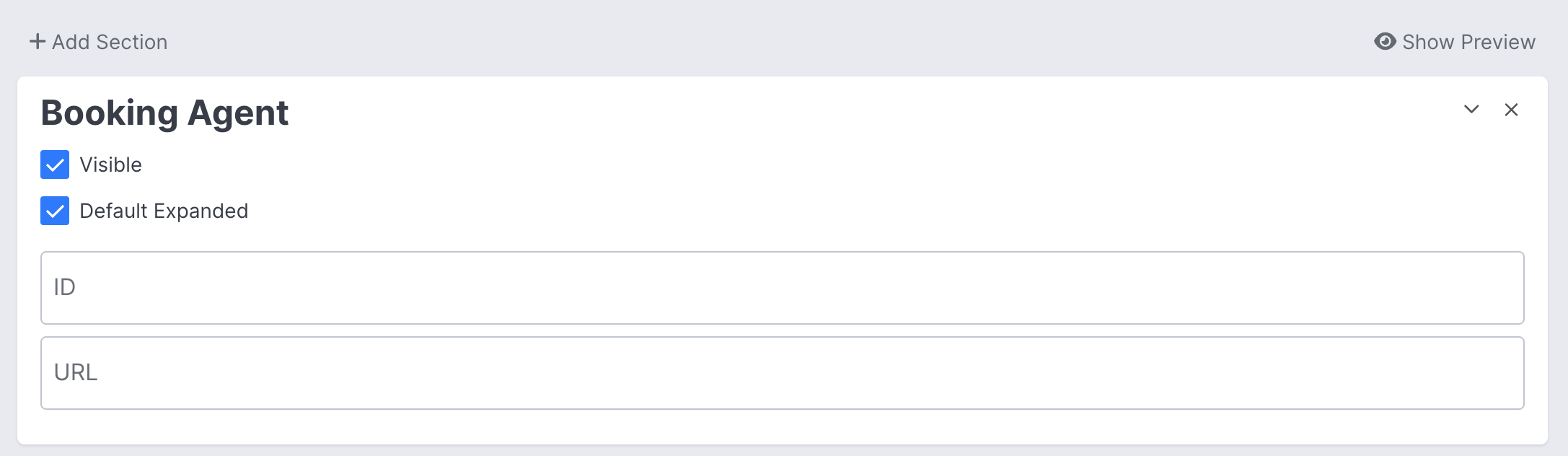
In addition to adding fields that will display in the conversation right hand side, Admins can also create and leverage custom right hand extensions within a Workspace. This can be a great way to add customized extensions that extend the capabilities of Quiq's agent console even further. Each extension requires an ID and URL, and you can decide whether it's expanded by default in the conversation right hand side, and whether or not it's visible to the agent.
For more information on creating custom extensions, refer to the developer documentation.
Settings tab
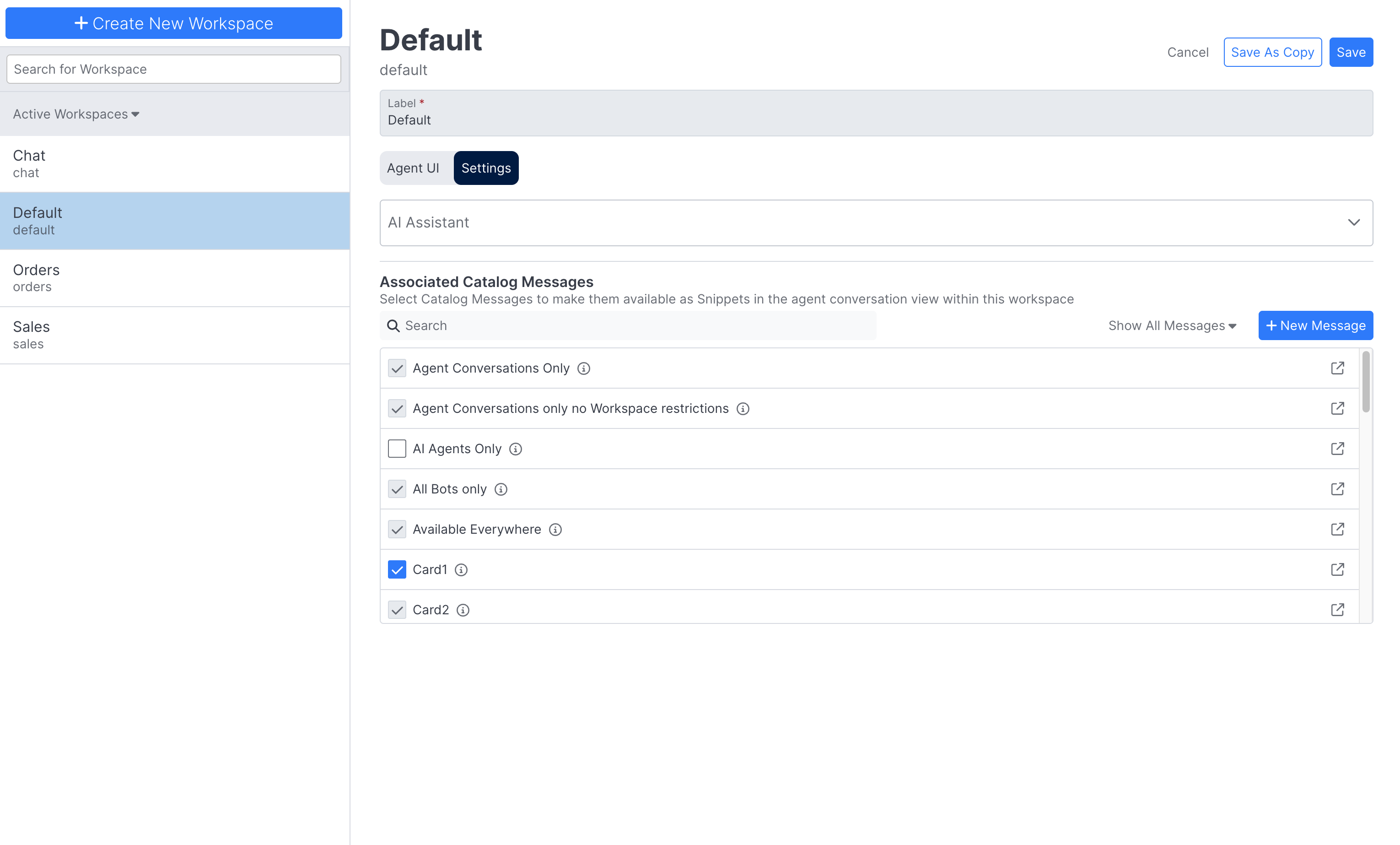
The Settings tab in the Workspace editor allows you to set an AI Assistant to use with the Workspace, and to see and define which global Catalog Messages will be available as Snippets in conversations when that Workspace is being used.
Selecting an AI Assistant
Each Workspace can leverage a unique AI Assistant, which can be built and configured in AI Studio. AI Assistants can generate suggested messages for your human agents to send, provide feedback and input on the conversation, write data to fields, and much more. An AI Assistant field is available on the Settings tab within a Workspace, where an AI Assistant can be selected.
If you're interesting in building out an AI Assistant and aren't currently using AI Studio, please reach out to your account manager.
Associating Catalog Messages
The Associated Catalog Messages section allows you to set which Catalog Messages will be available as Snippets in the agent conversation view when that Workspace is being used, and you can also create new Catalog Messages to associate with a Workspace with a + New Message button.
A list of all enabled global Catalog Messages in your Quiq site displays in this section. An Info icon displays for each Catalog Message in the list that displays its current Availability setting in a tooltip on hover, and an Open Catalog Message button is also available that when clicked opens that Catalog Message in a separate browser tab.
You can search for Catalog Messages by Label with the Search bar. The list of Catalog Messages can also be filtered with the Show All Messages / Show Associated / Show Unassociated filter - by default, Show All Messages is selected, so all available global Catalog Messages display. When Show Associated is selected, only the Catalog Messages that are already associated with that Workspace display. When Show Unassociated is selected, only the Catalog Messages that aren't associated with that Workspace display.
A checkbox is available for each Catalog Message in the list - the checkbox is editable if the Catalog Message can be associated/unassociated with the Workspace being edited, else it’s checked and read-only when the Catalog Message is currently available for all Workspaces. If the checkbox for a Catalog Message in the list is:
- Checked and read-only: The Catalog Message’s Availability is currently set to Available everywhere, or Available in specific areas with the Agent Conversations location selected, and it isn't restricted by Workspace so it’s currently available for all Workspaces - so it can't be set to only be available for the Workspace being edited.
- Unchecked and editable: The Catalog Message’s Availability is currently set to Available in specific areas and the Agent Conversations location isn’t selected yet, or Agent Conversations is selected and the Catalog Message is already restricted to at least one other Workspace - so it can be associated with the Workspace being edited.
- Checked and editable: The Catalog Message’s Availability is currently set to Available in specific areas with the Agent Conversations location selected, and it's already associated with the Workspace being edited - it can be unassociated with that Workspace as needed.
When creating a new Catalog Message with the + New Message button when editing a Workspace, the Catalog Message’s Availability is automatically set to Available in specific areas with the Agent Conversations location selected, and the Workspace being edited is automatically selected in the Workspaces selector list.
Restricting a Catalog Message to a specific Workspace only affects its availability as a Snippet in the agent conversation view - Workspaces don't apply to Snippet availability in the Start Conversation dialog, in Collaboration conversations, or in Outbound > Send Notifications.
Workspace Rules
Workspace Rules allow you to configure under what condition(s) a certain Workspace is used, and can be configured under the Workspace Rules section in Admin.
Workspaces can change dynamically during the course of a conversation, so for example if a customer is transferred to a new agent and the Queue they're in changes, the Workspace can adapt to that.
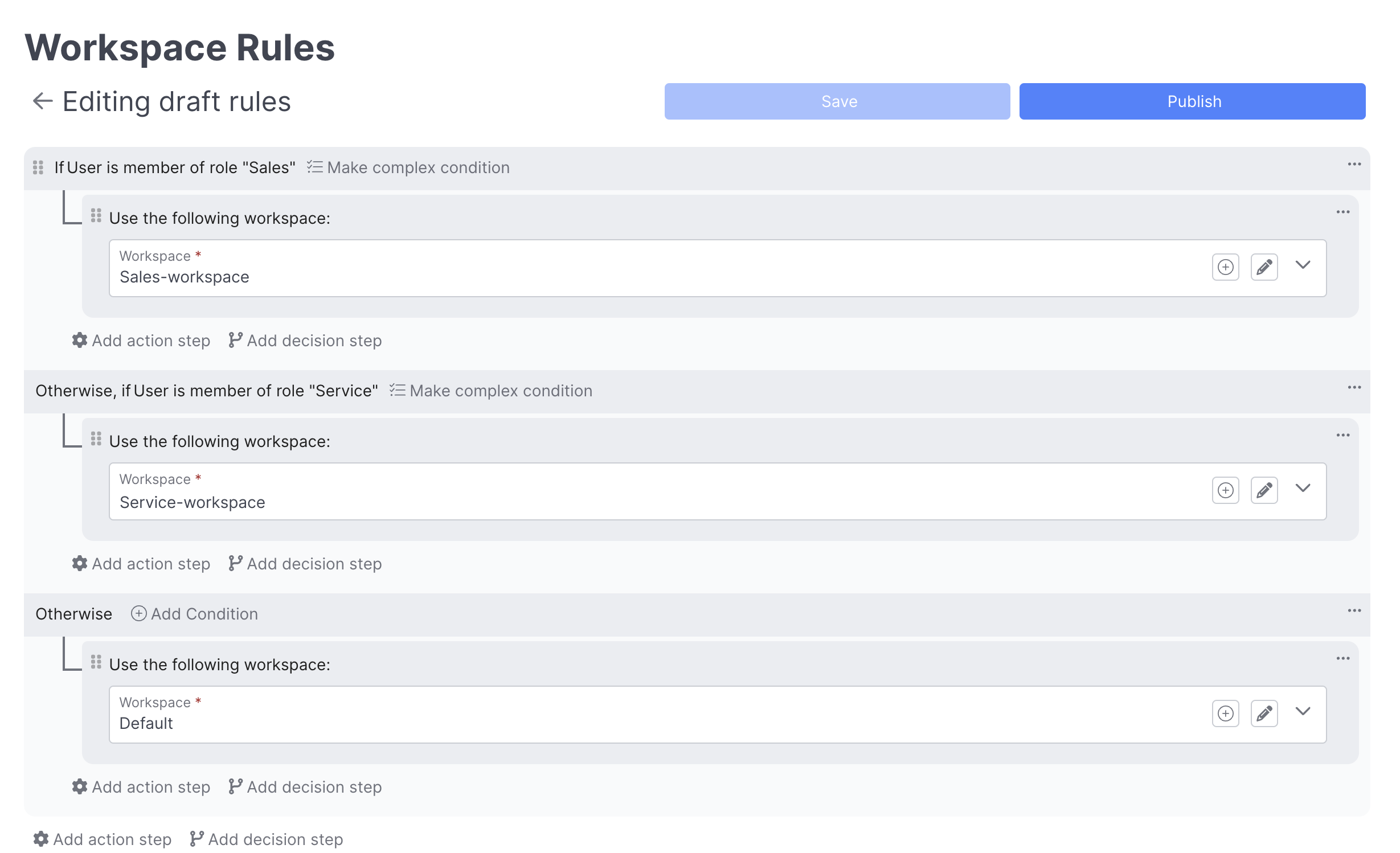
Workspace Rules have one Action available, Select the following workspace, that can be used to set the Workspace to be used depending on specific conditions that you can define by clicking the Add decision step button.
The default Workspace Rules configuration just contains one Use the following workspace Action, with the Default Workspace selected - so by default when no custom Workspace Rules have been defined yet, the Default Workspace is always used.
Common Workspace Rules
Below you'll find some common Workspace Rules, and how to set them up.
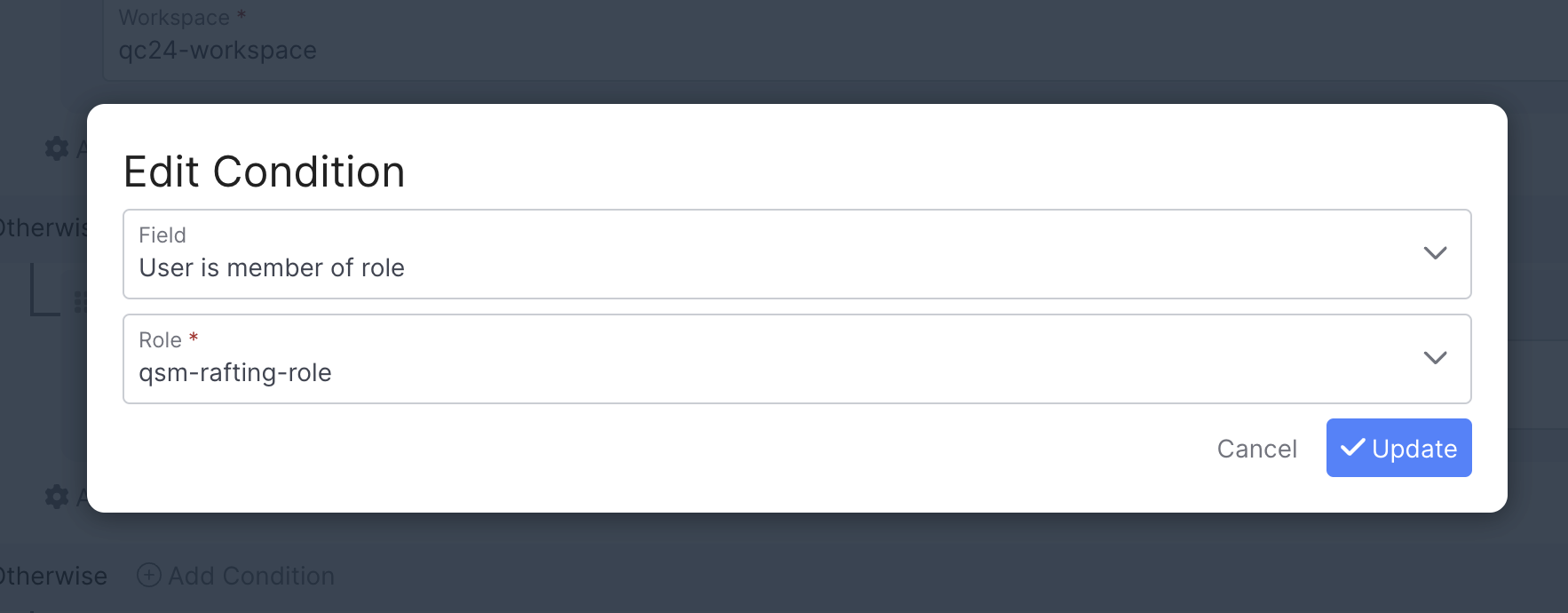
User is a Member of Role
One of the most common Workspace Rules, this rule uses the User is member of role field to determine which Workspace to use for a given conversation:
Conversation Queue
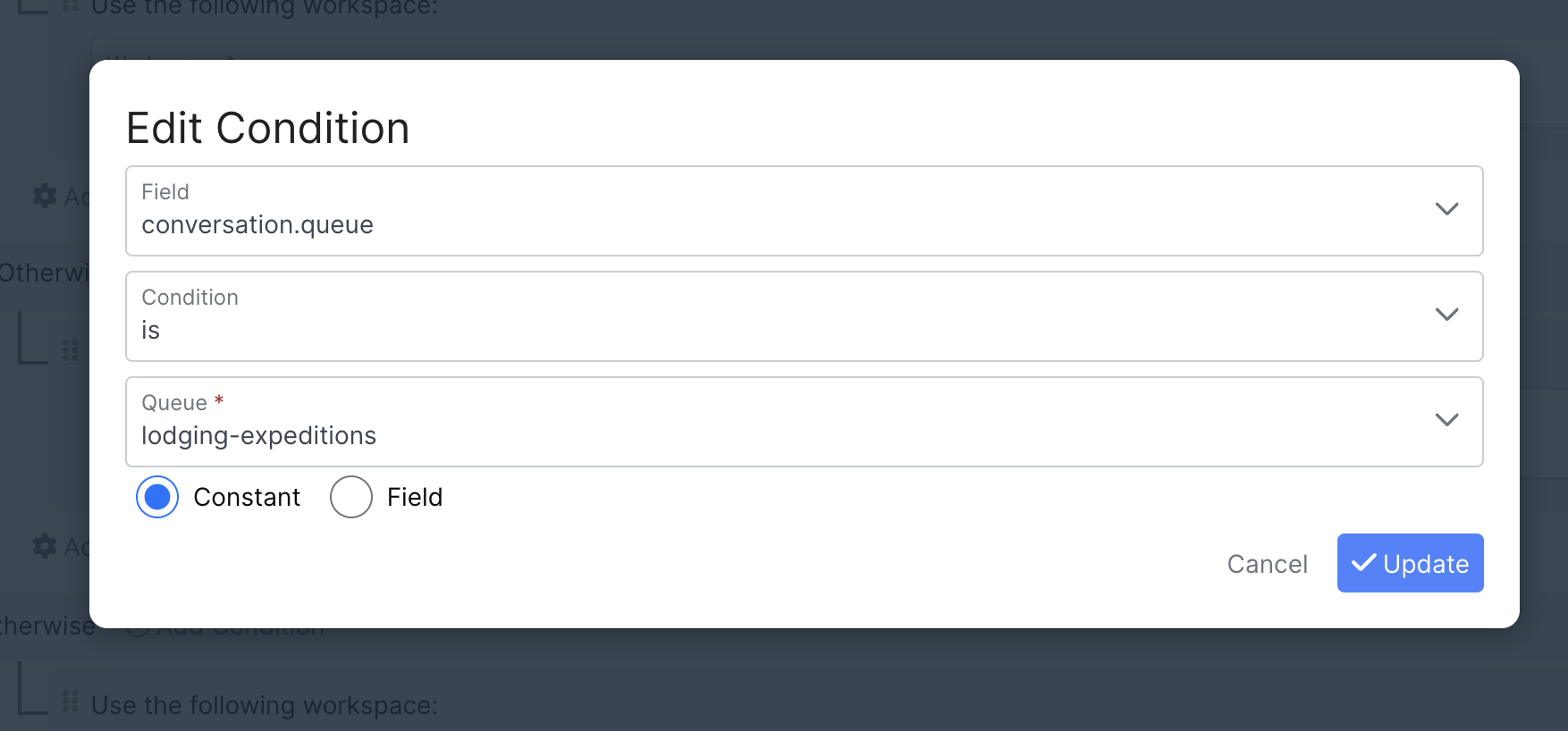
Use the conversation queue field to determine which Workspace to use depending on the Queue the conversation is associated with - this may be useful if a conversation may get transferred between Queues, and you'd like the Workspace to update accordingly.
Additional Conditions
Workspace Rules can also make use of both Conversation and Customer Custom Fields to determine the appropriate Workspace to use.
Updated 6 months ago